Keap XML-RPC Deprecation: What It Means and How to Prepare
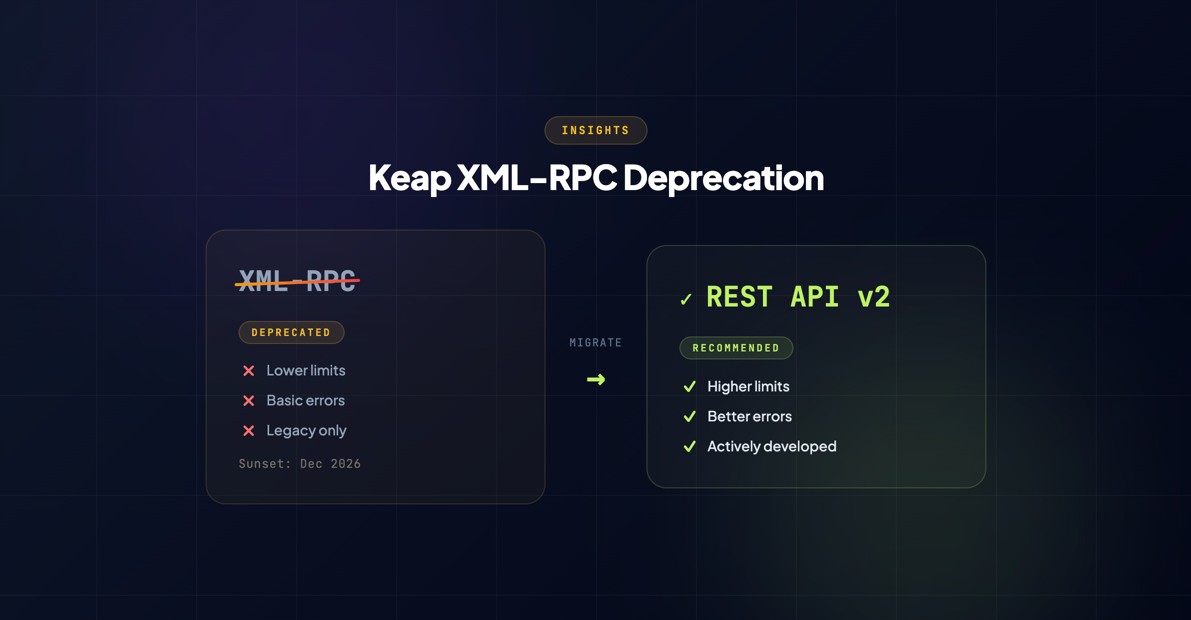
If you’ve been following Keap’s developer announcements, you’ve probably seen the news: XML-RPC is being deprecated in December 2026. If that sentence made your stomach drop, take a breath. We’ve got you covered.
Let’s break down what’s happening, why it matters, and what you need to do (spoiler: probably not much).
What Is XML-RPC, Anyway?
XML-RPC is the original API that Infusionsoft (now Keap) launched over a decade ago. It’s the protocol that made third-party integrations possible in the first place — including InfusedWoo’s earliest versions.
Think of it as the dial-up modem of APIs. It worked. It was groundbreaking at the time. But the world has moved on.
XML-RPC sends data as verbose XML documents over HTTP. Every request carries more overhead than necessary, and the authentication model (API keys passed in plain text) is showing its age. It served the ecosystem well, but modern alternatives are faster, more secure, and more capable.
Why Keap Is Moving On
Keap’s decision isn’t arbitrary. There are real, practical reasons behind the deprecation:
Security. XML-RPC relies on a static API key with no granular permissions. If that key leaks, everything is exposed. REST API v2 uses OAuth 2.0 with scoped access tokens that expire and refresh automatically.
Performance. XML payloads are significantly larger than their JSON equivalents. REST API v2 responses are leaner, parse faster, and put less strain on your server.
Feature parity. Keap has been building new features exclusively on the REST API for years. Some newer endpoints — like the updated e-commerce APIs and custom field management — simply don’t exist in XML-RPC. Maintaining two parallel APIs is expensive, and Keap is consolidating.
Industry standards. REST is the standard. Every major platform, payment gateway, and SaaS tool speaks REST. It’s what developers expect, and it’s what the tooling ecosystem supports.
In short: this is a good move. It just requires a bit of preparation.
What This Means for InfusedWoo Users
Here’s the good news: InfusedWoo has supported Keap’s REST API v2 since version 4.5, and it’s been the default connection method for all new installations.
If you installed or updated InfusedWoo in the last few months, there’s a strong chance you’re already running on REST API v2. No action needed.
If you’ve been running InfusedWoo for a while and haven’t changed your API settings, some of your services might still be using XML-RPC under the hood. That’s fine for now — it will keep working until December 2026. But there’s no reason to wait.
How to Check Your Settings
Checking is simple:
- Go to WooCommerce > InfusedWoo > Settings > API Settings
- Look at the Default API Mode setting at the top
- Below that, you’ll see the per-service overrides
If your default mode says “REST API v2,” you’re in good shape. If any individual services show “XML-RPC” or “Legacy,” those are the ones to migrate.
Each service (contact sync, order sync, tag operations, etc.) can be set independently. This was intentional — it lets you migrate one service at a time and verify everything works before moving on.
REST API v2 vs. XML-RPC: A Quick Comparison
Here’s how the two stack up side by side:
| Feature | XML-RPC | REST API v2 |
|---|---|---|
| Data Format | XML | JSON |
| Authentication | Static API Key | OAuth 2.0 (auto-refresh) |
| Rate Limits | 10,000/day | 25,000/day (more with Custom OAuth) |
| Response Size | Larger (XML overhead) | Smaller (JSON) |
| New Endpoints | Frozen | Actively developed |
| Webhook Support | Limited | Full support |
| Batch Operations | No | Yes |
| Security | Basic | Token-based, scoped |
| Status After Dec 2026 | Discontinued | Active |
The performance difference is noticeable. In our testing, REST API v2 calls complete 30-40% faster on average, and the reduced payload size means less memory usage on your WordPress server.
Your Migration Checklist
Here’s what we recommend doing now, well ahead of the December deadline:
1. Update InfusedWoo to the Latest Version
Make sure you’re running InfusedWoo 4.5 or later. The REST API v2 integration requires the updated OAuth connection flow. You can check your version under Plugins > Installed Plugins.
2. Switch Your Default API Mode
Navigate to Settings > API Settings and set the default to “REST API v2.” If you haven’t connected via OAuth yet, InfusedWoo will walk you through the authorization flow. It takes about 30 seconds.
3. Migrate Per-Service Overrides
If you had any services locked to XML-RPC for compatibility reasons, switch them one at a time. After each switch:
- Run a test order or contact sync
- Check InfusedWoo’s Connection Log for errors
- Verify the data landed correctly in Keap
4. Watch for Legacy Action Set Warnings
InfusedWoo will show a dashboard notice if it detects any automation recipes still referencing XML-RPC-specific endpoints. Update those recipes to use the REST-compatible actions. In most cases, the recipe editor will offer a one-click migration.
5. Consider Custom OAuth for High-Volume Stores
If your store processes more than 20,000 API calls per day, look into setting up a Custom OAuth application in Keap’s developer portal. This gives you dedicated rate limits separate from the shared pool. InfusedWoo 4.5 supports Custom OAuth natively — just enter your client credentials in the API Settings.
What Happens If You Do Nothing?
Your store will continue working normally until Keap shuts down XML-RPC endpoints in December 2026. After that date, any services still using XML-RPC will stop syncing data.
InfusedWoo will detect the failures and show warnings in your dashboard, but the fix at that point will be the same as the fix today: switch to REST API v2.
There’s no advantage to waiting. The REST API is faster, more reliable, and more capable. Migrating now means you get the benefits immediately and avoid any last-minute scramble.
We’ve Got You Covered
We’ve been planning for this transition for years. InfusedWoo’s REST API v2 integration was built from the ground up — it’s not a wrapper around the old XML-RPC calls. Every service has been optimized for the REST endpoints, with proper error handling, automatic token refresh, and the SAK backup key as a failover safety net.
If you run into any issues during migration, our support team is here to help. We’ve done this migration with hundreds of stores already, and we know the edge cases.
The XML-RPC era served us all well. But the future is REST, and InfusedWoo is already there.
For detailed configuration steps, check out our API Settings documentation.