How One Store Recovered $12K/Month with Automated Cart Abandon Emails
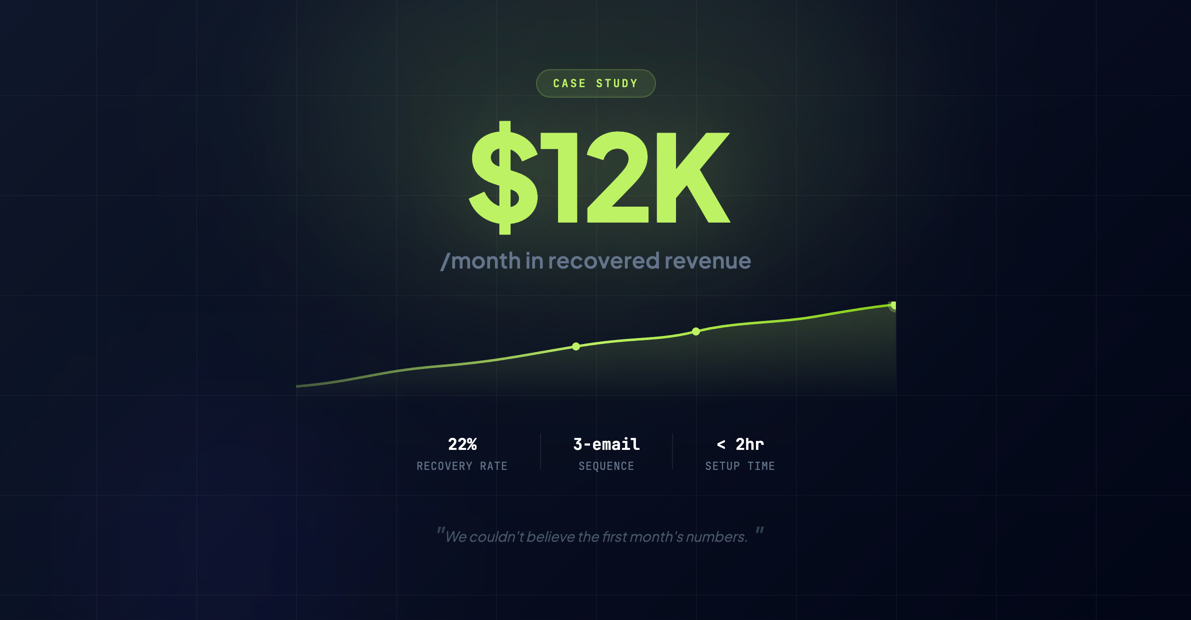
Sarah runs NutriBloom, an online supplement store built on WooCommerce. The store does around $80,000 per month in revenue, sells about 140 SKUs, and has a loyal customer base built over six years. By most measures, things were going well.
But Sarah had a nagging feeling she was leaving money on the table. She just didn’t know how much.
The Wake-Up Call
In October 2025, Sarah installed a basic analytics tool to track her checkout funnel. The numbers hit her like a cold shower: 68% of shoppers who added items to their cart never completed the purchase.
She did the math on a napkin. If $80K in monthly revenue represented only 32% of purchase intent, that meant roughly $170,000 worth of carts were being created each month — and $90,000 was walking away. Even accounting for “just browsing” shoppers who were never going to buy, the lost revenue was staggering.
“I knew cart abandonment was a thing,” Sarah said. “I just assumed it was maybe 30-40%. Seeing 68% felt like a gut punch. That’s real money disappearing every single day.”
She’d been using Keap as her CRM for three years and InfusedWoo to sync her WooCommerce data. But she’d never set up cart abandon tracking. It was one of those “I’ll get to it eventually” projects that kept sliding down the priority list.
November was the month she finally got to it.
The Setup: Three Emails, One Afternoon
Sarah’s approach was straightforward. She followed InfusedWoo’s cart abandon documentation and built a 3-email recovery sequence in Keap’s Campaign Builder.
The trigger: InfusedWoo’s reachedcheckout API goal, which fires automatically when a shopper hits the WooCommerce checkout page. No custom code. No JavaScript snippets to install. Just enable it in InfusedWoo settings and it starts tracking.
Email 1 — “You Left Something Behind” (1 hour after abandonment)
Short, friendly, zero pressure. A reminder of what was in their cart with product images pulled from WooCommerce. One big button: “Complete Your Order.” The cart restore link — generated automatically by InfusedWoo — brought customers back to checkout with their cart fully intact.
Email 2 — “Still Thinking About It?” (24 hours later)
Added a customer review snippet for the most popular product in the abandoned cart. Included a note about NutriBloom’s 30-day money-back guarantee. Same cart restore link.
Email 3 — “Here’s 10% Off” (48 hours later)
The incentive play. A 10% discount code with a 72-hour expiration. Sarah debated whether to offer a discount at all — she didn’t want to train customers to abandon carts on purpose. But she decided to test it for 90 days and evaluate.
The stop logic was important: if a customer completed their purchase at any point, InfusedWoo reported the order to Keap, which automatically pulled them out of the recovery sequence. No embarrassing “come back!” emails to people who already bought.
The entire setup took about three hours, including writing the email copy and testing the cart restore links.
The Results: $12,246/Month in Recovered Revenue
Sarah let the sequence run for 90 days before pulling the numbers. Here’s what she found:
| Metric | Result |
|---|---|
| Abandoned carts tracked | 3,847 |
| Email 1 open rate | 47.3% |
| Email 2 open rate | 38.1% |
| Email 3 open rate | 34.6% |
| Total carts recovered | 578 |
| Recovery rate | 15.02% |
| Average recovered order value | $63.58 |
| Monthly recovered revenue | $12,246 |
| Projected annual recovery | $146,952 |
The breakdown by email was telling: Email 1 (the simple reminder) drove 61% of all recoveries. Email 2 contributed 22%. Email 3, the discount email, accounted for 17%.
“The first email doing most of the heavy lifting surprised me,” Sarah said. “Most of these people just needed a nudge. They weren’t price-sensitive — they were distracted.”
The Unexpected Benefits
Beyond the raw revenue numbers, Sarah noticed a few things she hadn’t anticipated:
Customer feedback improved. Several customers replied to the recovery emails thanking her for the reminder. One wrote: “I totally forgot about this order — thank you for following up!” The emails felt helpful, not spammy, because the tone was right.
She identified a checkout bug. The recovery data showed an unusual spike in abandonment on mobile devices. After investigating, Sarah found that her shipping calculator was breaking on certain Android browsers. Fixing that bug reduced her baseline abandonment rate by 4%.
The discount email was less necessary than expected. Since Email 1 and 2 recovered 83% of the total, Sarah considered removing the discount email entirely. She decided to keep it but reduced the discount from 10% to 7% with no measurable impact on recovery rate.
What Sarah Would Do Differently
Looking back, Sarah’s biggest regret was waiting so long to set it up.
“I spent two years with InfusedWoo running and never turned on cart abandon tracking. If the recovery rate was consistent, that’s roughly $290,000 I left on the table. That’s a hard number to think about.”
Her other lessons learned:
Write the emails in your own voice. Sarah’s first drafts were too corporate. She rewrote them in the same casual tone she uses in her newsletter, and open rates jumped 8 percentage points.
Don’t over-design the emails. Her best-performing email was the plainest one — Email 1 with a simple text layout, one product image, and a button. The more “designed” versions she A/B tested actually performed worse.
Watch the discount carefully. After 90 days, Sarah checked whether customers were intentionally abandoning carts to trigger the discount. She found a small number of repeat offenders (about 2%) and excluded them using Keap tags. Problem solved.
Her Favorite Feature
When asked what surprised her most about the setup, Sarah didn’t hesitate: “The cart restore link. That’s the thing that makes it all work.”
She’d used other cart recovery tools before that sent customers back to the store homepage or product page, forcing them to re-add items and start over. InfusedWoo’s cart restore link drops them right back at checkout with everything intact — same products, same quantities. And because it’s server-side rather than cookie-based, it works even if the customer clicks the email on a different device.
“One customer told me she abandoned on her laptop at work, got the email on her phone during her commute, tapped the link, and checked out in 30 seconds. That’s the kind of experience that builds loyalty.”
The Bottom Line
Sarah’s story isn’t unusual. It’s not even particularly aggressive in terms of recovery rate — 15% is solid but well within the range that InfusedWoo stores regularly achieve. The math just works in your favor when you’re recovering sales from people who already wanted to buy.
$12,246 per month. $146,952 per year. From an automation that took one afternoon to build and runs entirely on its own.
If you’re running WooCommerce with Keap and you haven’t set up cart abandon recovery yet, the question isn’t whether you can afford to — it’s whether you can afford not to.
Ready to set up your own recovery sequence? Start with our Cart Abandon setup guide.