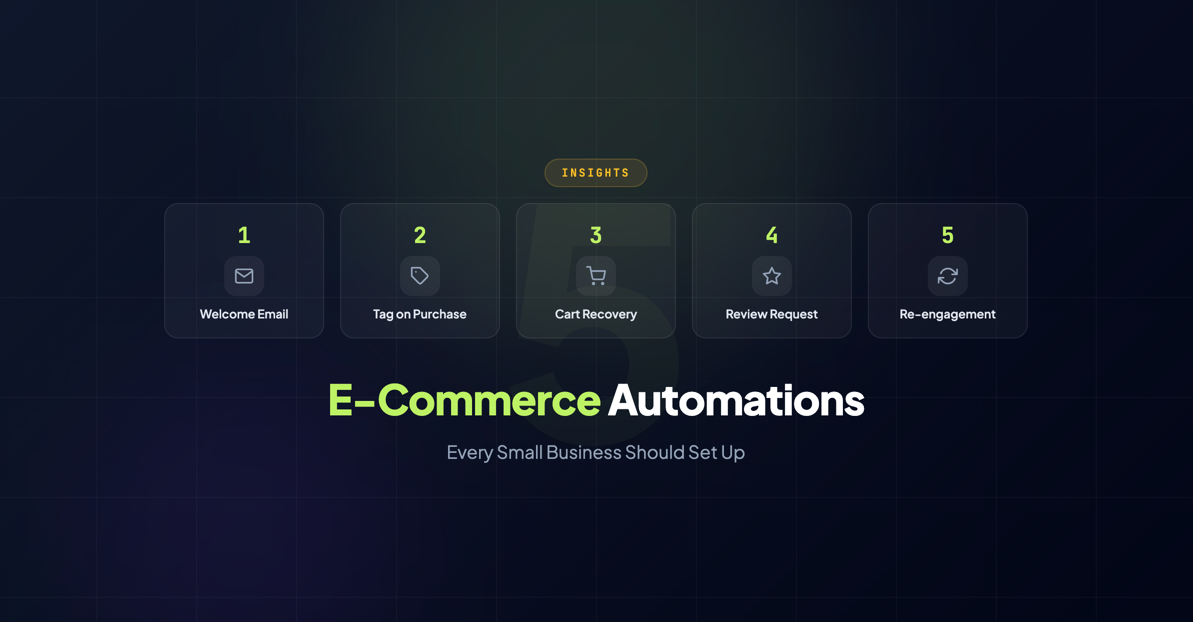
5 E-Commerce Automations Every Small Business Should Set Up
There’s a moment every growing ecommerce store owner hits. It usually sounds something like: “I can’t believe I just spent three hours copying and pasting email addresses.”
Automation isn’t about replacing the human touch in your business. It’s about freeing you up to actually provide it. When the routine stuff runs on autopilot, you can spend your time on the things that actually require a human brain — product development, customer relationships, strategy, or maybe just sleeping more than five hours a night.
Here are five automations that deliver outsized results for the time they take to set up. We’re talking real revenue impact, not theoretical marketing-speak.
1. Welcome Email Sequence for New Customers
Why it matters: First impressions aren’t just a cliche — they’re a revenue driver. A new customer just trusted you with their money. What happens in the next 48 hours shapes whether they become a repeat buyer or a one-and-done.
The business impact: Welcome emails generate 4x more opens and 5x more clicks than regular marketing emails, according to data from Experian. They also set expectations, reduce buyer’s remorse, and start building a relationship before the package even arrives.
What a good welcome sequence looks like:
- Email 1 (Immediate): Thank them for their purchase. Confirm what they ordered. Set delivery expectations. Keep it warm and human — not a corporate template.
- Email 2 (Day 2-3): Share something useful. A getting-started guide for your product, care instructions, or a “here’s what other customers love” recommendation. Value first, selling later.
- Email 3 (Day 5-7): Introduce your brand story. Why you started the business, what you stand for, what makes your products different. People buy from people.
How InfusedWoo makes it easy: When a customer places their first order, InfusedWoo automatically syncs the contact to Keap and applies a “New Customer” tag. In Keap, you build a campaign that triggers on that tag — and the sequence runs without you doing anything. Set it up once, and it works for every new customer from now on.
2. Abandoned Cart Recovery
Why it matters: This is the closest thing to free money in ecommerce. On average, nearly 70% of online shopping carts are abandoned before checkout (Baymard Institute). That’s not a leak in your funnel — it’s a waterfall.
The business impact: Abandoned cart emails recover between 5-15% of otherwise-lost sales. For a store doing $50K/month with a typical abandonment rate, that’s an extra $1,750 to $5,250 per month. From a single automation.
Let that sink in for a second.
What a good recovery sequence looks like:
- Email 1 (1 hour after abandonment): Simple reminder. “Hey, you left something behind.” Include the product image and a direct link back to their cart. No discount yet — many people just got distracted.
- Email 2 (24 hours): Address objections. “Still thinking about it?” Include social proof — reviews, ratings, or a quick testimonial. Maybe mention your return policy or guarantee.
- Email 3 (48-72 hours): This is where you can offer an incentive if appropriate — free shipping, a small discount, or a bonus item. Create gentle urgency without being pushy.
The InfusedWoo angle: Cart data syncs to Keap in real time, including the specific products, quantities, and cart value. This means your recovery emails can include the actual items the customer was considering — not generic “come back” messages that feel like spam.
3. Post-Purchase Follow-Up and Review Request
Why it matters: The silence after a purchase is a missed opportunity. Your customer is at peak excitement about your product — they just bought it! — and most stores respond to that excitement with… nothing. Maybe a shipping notification. Maybe.
The business impact: Post-purchase emails have some of the highest engagement rates of any email type. And reviews? They’re the engine of ecommerce trust. Products with reviews convert 270% better than products without them (Spiegel Research Center). Every review you collect makes your next sale easier.
What a good post-purchase sequence looks like:
- Day 1-2 (after delivery): “How’s everything?” Check in, make sure the product arrived safely, offer help if needed. This isn’t a selling email — it’s a relationship email.
- Day 7-10: Ask for a review. Make it easy — one click to the review page. Keep the ask simple: “Would you mind sharing your experience?” People are surprisingly willing to help when you just ask nicely.
- Day 14-21: If they bought a consumable or a product with accessories, this is a natural time for a relevant recommendation. “Customers who bought X also love Y.” Only send this if it’s genuinely relevant.
With InfusedWoo: Order status changes sync automatically. When an order is marked “completed” in WooCommerce (i.e., delivered), that triggers the post-purchase sequence in Keap. No manual checking, no guessing when things arrived.
4. VIP Customer Tagging Based on Spend
Why it matters: Not all customers are equal — and that’s okay. Your top 10-20% of customers typically drive 50-80% of revenue (the Pareto principle in action). Treating them the same as someone who bought a $12 item once is leaving money and loyalty on the table.
The business impact: VIP customers who feel recognized spend more, refer more, and churn less. A loyalty program or VIP tier doesn’t have to be complicated — sometimes just a personal thank-you email or early access to a sale is enough to cement the relationship.
What VIP tagging looks like in practice:
Define your tiers based on what makes sense for your business. Common approaches:
- Spend-based: Lifetime spend over $500 = Silver, over $1,000 = Gold, over $2,500 = Platinum
- Frequency-based: 3+ orders = Repeat Customer, 5+ orders = Loyal Customer, 10+ orders = VIP
- Hybrid: Combine spend and frequency for a more nuanced picture
Once tagged, you can:
- Send VIP-only promotions and early access offers
- Include handwritten thank-you notes in their shipments (a small touch that customers rave about)
- Invite them to a private Facebook group or community
- Offer them a referral incentive — they’re already fans, make it easy for them to share
How InfusedWoo helps: InfusedWoo tracks lifetime purchase data and syncs it to Keap. You can set up automation recipes that automatically apply VIP tags when a customer crosses a spending threshold. No manual spreadsheet audits, no “I should really check who our best customers are” tasks that never get done.
5. Win-Back Campaign for Inactive Customers
Why it matters: Acquiring a new customer costs 5-25x more than retaining an existing one (Harvard Business Review). Yet most stores pour their marketing budget into acquisition and ignore the customers who already bought from them but went quiet.
The business impact: Win-back campaigns typically see 12-15% open rates and can reactivate 3-10% of lapsed customers. That might sound modest, but consider: these are people who already trust you enough to have purchased once. The friction to buy again is far lower than converting a stranger.
What a good win-back sequence looks like:
First, define “inactive.” For most ecommerce stores, 90-120 days without a purchase is a reasonable threshold, but it depends on your product cycle. If you sell coffee, 30 days might be inactive. If you sell furniture, 2 years might be normal.
- Email 1 (“We miss you”): Acknowledge it’s been a while. Show them what’s new — new products, new features, improvements since they last visited. Keep it friendly, not guilt-trippy.
- Email 2 (1 week later): Offer an incentive. A “welcome back” discount, free shipping, or a bonus with purchase. Make it time-limited to encourage action.
- Email 3 (2 weeks later): The last attempt. “Is this goodbye?” Give them an easy way to stay on your list (maybe they just don’t need to buy right now) or unsubscribe cleanly. Respect goes a long way — some of these people will come back months later because you didn’t spam them into oblivion.
The InfusedWoo approach: Because InfusedWoo syncs purchase dates and order history to Keap, you can build segments based on last-purchase date with precision. Set up a campaign in Keap that targets contacts with a “Last Purchase” date older than your threshold, exclude anyone who’s already in an active sequence, and let it run.
The Compound Effect
Here’s what’s interesting about these five automations: each one is valuable on its own, but together they create a system. New customers get welcomed properly, which increases the chance they buy again. When they do, the post-purchase sequence asks for a review and nudges them toward a third purchase. Their spend accumulates, and eventually they get VIP status — which makes them feel valued and keeps them active. And if they do go quiet, the win-back campaign catches them before they’re gone for good.
It’s a flywheel, not a funnel. And once it’s running, it runs without you.
Getting Started
You don’t have to build all five at once. In fact, please don’t — that’s a recipe for burnout and half-finished automations that never get activated.
Pick one. We’d suggest starting with either the welcome sequence (highest long-term impact) or abandoned cart recovery (fastest revenue impact). Get it running, let it work for a few weeks, measure the results, then build the next one.
If you’re using InfusedWoo with Keap, most of the data plumbing is already done. Contacts sync, orders sync, tags apply — you just need to build the campaigns in Keap and connect them to the right triggers.
Need help figuring out which automation to start with? Check out our automation recipes guide for step-by-step walkthroughs, or reach out to our team — we’ve helped thousands of store owners set these up.
Ready to put your store on autopilot? Try InfusedWoo free and start building automations that work while you sleep.