Abandoned Cart Recovery: The Easiest Revenue You're Leaving on the Table
Imagine you run a coffee shop. Every morning, seven out of ten customers walk up to the counter, order a latte, and then — just before handing over their credit card — turn around and leave. No explanation. Just gone.
You’d lose your mind, right?
That’s exactly what’s happening in your WooCommerce store every single day. And most store owners have no idea how much money is quietly walking out the door.
The $18 Billion Problem
According to the Baymard Institute, the average online cart abandonment rate hovers around 70.19%. That’s not a typo. Seven out of ten shoppers who add items to their cart never complete the purchase.
For a store doing $50K/month in revenue, that means roughly $117K worth of carts were created — and $67K just evaporated. Even recovering a fraction of that changes the math dramatically.
The good news? Abandoned cart recovery is one of the highest-ROI marketing activities you can implement. It’s not about driving new traffic or running expensive ad campaigns. It’s about converting people who already wanted your products.
Why People Abandon (It’s Not Always What You Think)
Before you can recover abandoned carts, it helps to understand why people bail in the first place. The reasons fall into a few buckets:
Unexpected costs. This is the number one reason, every single year. Shipping fees, taxes, or handling charges that appear at checkout create sticker shock. If your $45 product suddenly costs $58.99 at checkout, you’ve broken trust.
“Just browsing.” Many shoppers use the cart as a wishlist or comparison tool. They’re not ready to buy — they’re researching. This is totally normal behavior, and your recovery emails can gently nudge them back when they’re ready.
Complicated checkout. Every extra form field, every required account creation, every unnecessary step is a leak in your funnel. If checking out feels like filing taxes, people will bail.
Security concerns. Shoppers who don’t recognize your payment processor or see an unfamiliar checkout page may hesitate. Trust badges and familiar payment options matter more than most store owners realize.
Technical issues. Slow page loads, mobile display problems, or payment gateway errors. These are fixable, but only if you know they’re happening.
The key insight is this: most cart abandoners aren’t rejecting your product. They got distracted, got confused, or hit a friction point. A well-timed email can bring many of them back.
The 3-Email Recovery Sequence That Works
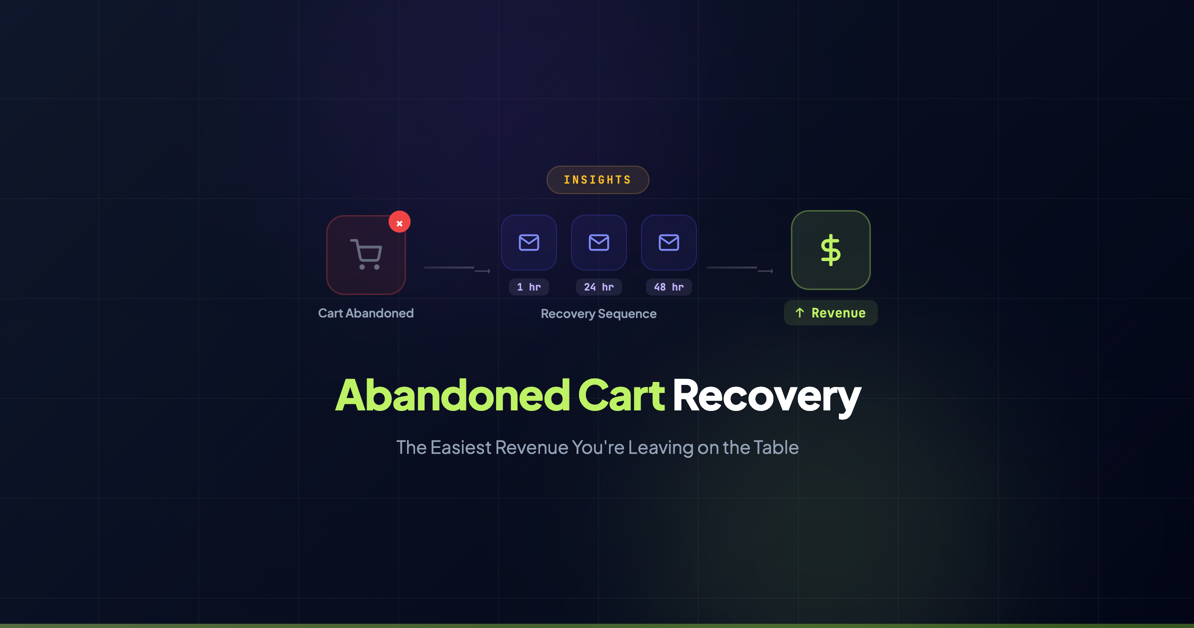
There’s a reason virtually every ecommerce expert recommends a three-email sequence. It balances persistence with restraint. Here’s the framework that consistently delivers results:
Email 1: The Helpful Reminder (1 Hour After Abandonment)
Goal: Assume good intent. Maybe they got distracted, their browser crashed, or the baby started crying.
Tone: Friendly and helpful — not salesy.
Subject line examples:
- “Did something go wrong with your order?”
- “You left something behind”
- “Your cart is waiting for you”
Content: Show them exactly what they left in their cart (product images, names, prices). Include a single, clear call-to-action button that takes them back to checkout. Don’t offer a discount yet — many people will convert from the reminder alone.
This first email typically has the highest open rate (40-50%) and drives the majority of recoveries. Timing matters: one hour is the sweet spot. Too soon feels aggressive. Too late and they’ve moved on.
Email 2: Urgency and Social Proof (24 Hours Later)
Goal: Create a reason to act now rather than later.
Tone: Slightly more urgent, but still helpful.
Subject line examples:
- “Your cart items are selling fast”
- “Still thinking it over? Here’s what others are saying”
- “Don’t miss out on [Product Name]”
Content: Reshow the cart contents. Add urgency elements — limited stock warnings, time-limited cart holds, or customer reviews of the products they’re considering. If you have testimonials or star ratings, this is where they shine.
Email 3: The Incentive (48 Hours Later)
Goal: Sweeten the deal for the holdouts.
Tone: Generous and final.
Subject line examples:
- “Here’s 10% off to complete your order”
- “We saved your cart (and a discount)”
- “Last chance: your items + a special offer”
Content: This is where you play your discount card. A 10-15% discount or free shipping offer can convert shoppers who were on the fence about price. Make the offer time-limited (48-72 hours) to create genuine urgency.
A word of caution: Don’t train your customers to expect discounts by offering them too aggressively. Some stores skip Email 3 entirely for first-time abandoners and only send it to repeat visitors. Test what works for your audience.
Subject Line Tips That Move the Needle
Your recovery sequence is only as good as your open rates. A few things we’ve seen work well:
- Personalization wins. Including the customer’s name or the product name in the subject line consistently outperforms generic copy.
- Curiosity beats urgency. “Did you forget something?” outperforms “BUY NOW BEFORE IT’S GONE” every time.
- Keep it short. Under 50 characters. Mobile email clients truncate aggressively.
- Test emoji sparingly. A single cart emoji can boost open rates by 5-10%, but overuse kills credibility.
- Avoid spam triggers. Words like “FREE!!!” or excessive caps will land you in the promotions tab — or worse.
How InfusedWoo + Keap Makes This Effortless
Here’s where it gets good. InfusedWoo’s cart abandon tracking works seamlessly with Keap’s Campaign Builder to automate the entire recovery flow — no custom code, no third-party tools, no duct tape.
How it works:
When a customer reaches your WooCommerce checkout page, InfusedWoo fires the reachedcheckout API goal in Keap. This starts the clock on your recovery campaign. If the customer completes their purchase, InfusedWoo automatically reports the purchase to Keap, which stops the recovery sequence. No awkward “come back!” emails after someone already bought.
The cart restore link is the real magic. InfusedWoo generates a unique, GDPR-compliant link for each abandoned session. When the customer clicks it, their cart is fully restored — same products, same quantities, same state. No friction. They pick up right where they left off.
Why this matters for GDPR: InfusedWoo’s cart restore links don’t rely on tracking cookies or persistent browser storage. The cart data is stored server-side and associated with the contact record in Keap. The link works across devices, across browsers, and doesn’t require the customer to be logged in. It’s privacy-friendly by design.
Building the sequence in Campaign Builder is straightforward. You create a campaign with the reachedcheckout goal as the trigger, add your three timed emails, and include purchase-based stop logic. InfusedWoo handles the data flow. Keap handles the email delivery and timing. You handle the coffee while the revenue rolls in.
For a full walkthrough of the setup, check out our Cart Abandon documentation.
The Numbers Don’t Lie
Industry benchmarks for well-executed cart recovery programs:
- Recovery rate: 5-15% of abandoned carts converted
- Average open rate: 40-45% for the first email
- Revenue per email: 3-5x higher than standard promotional emails
- ROI: For every $1 spent on cart recovery, stores see $5-$12 back
For a store doing $50K/month with a 70% abandonment rate, even a conservative 8% recovery rate adds $9,300/month in recaptured revenue. That’s over $111K/year — from emails that run on autopilot.
Stop Leaving Money on the Table
Cart abandonment isn’t going away. Shoppers will always browse, compare, and get distracted. But the stores that thrive are the ones that follow up — consistently, helpfully, and automatically.
If you’re running WooCommerce with Keap and you don’t have a cart recovery sequence in place, you’re leaving the easiest revenue on the table. InfusedWoo makes the integration painless, and the math makes it a no-brainer.
Set it up once. Let it run. Watch the recovered revenue stack up.